
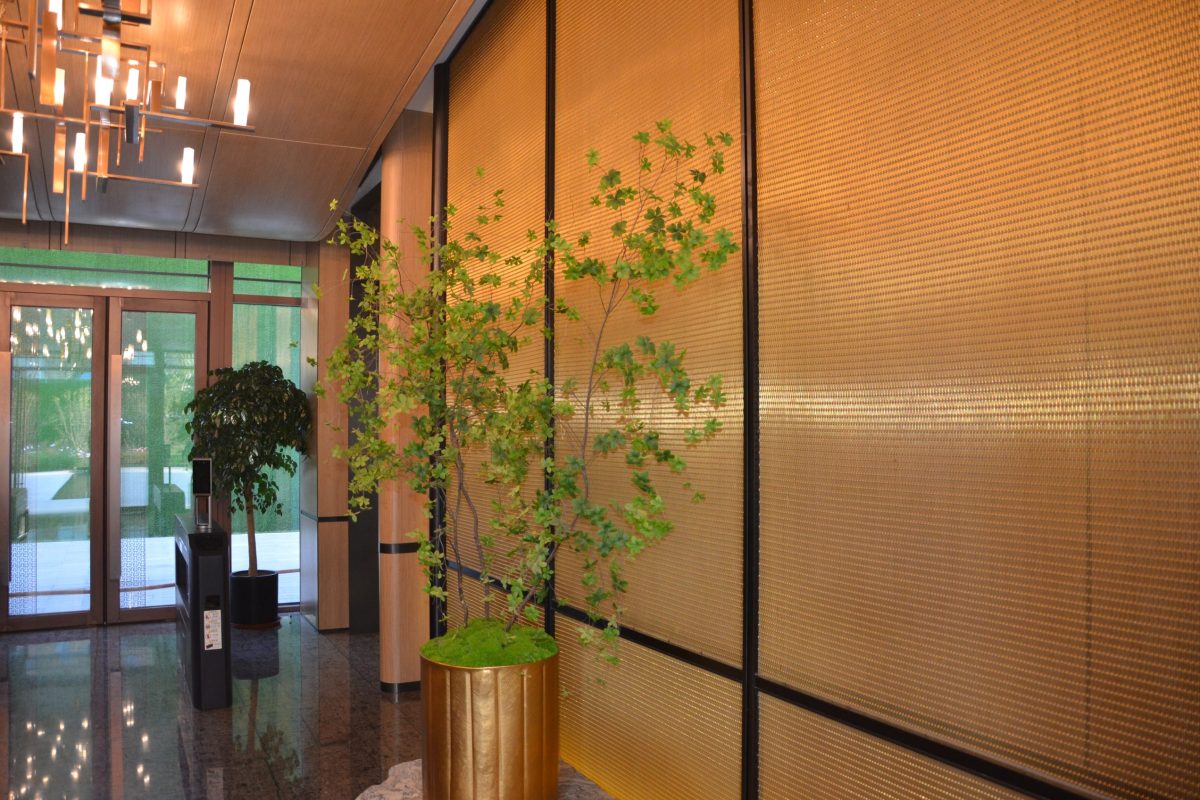
Customer Background: A Dubai-based hotel interior design firm undertaking a renovation project for the lobby and corridors of a high-end boutique hotel.
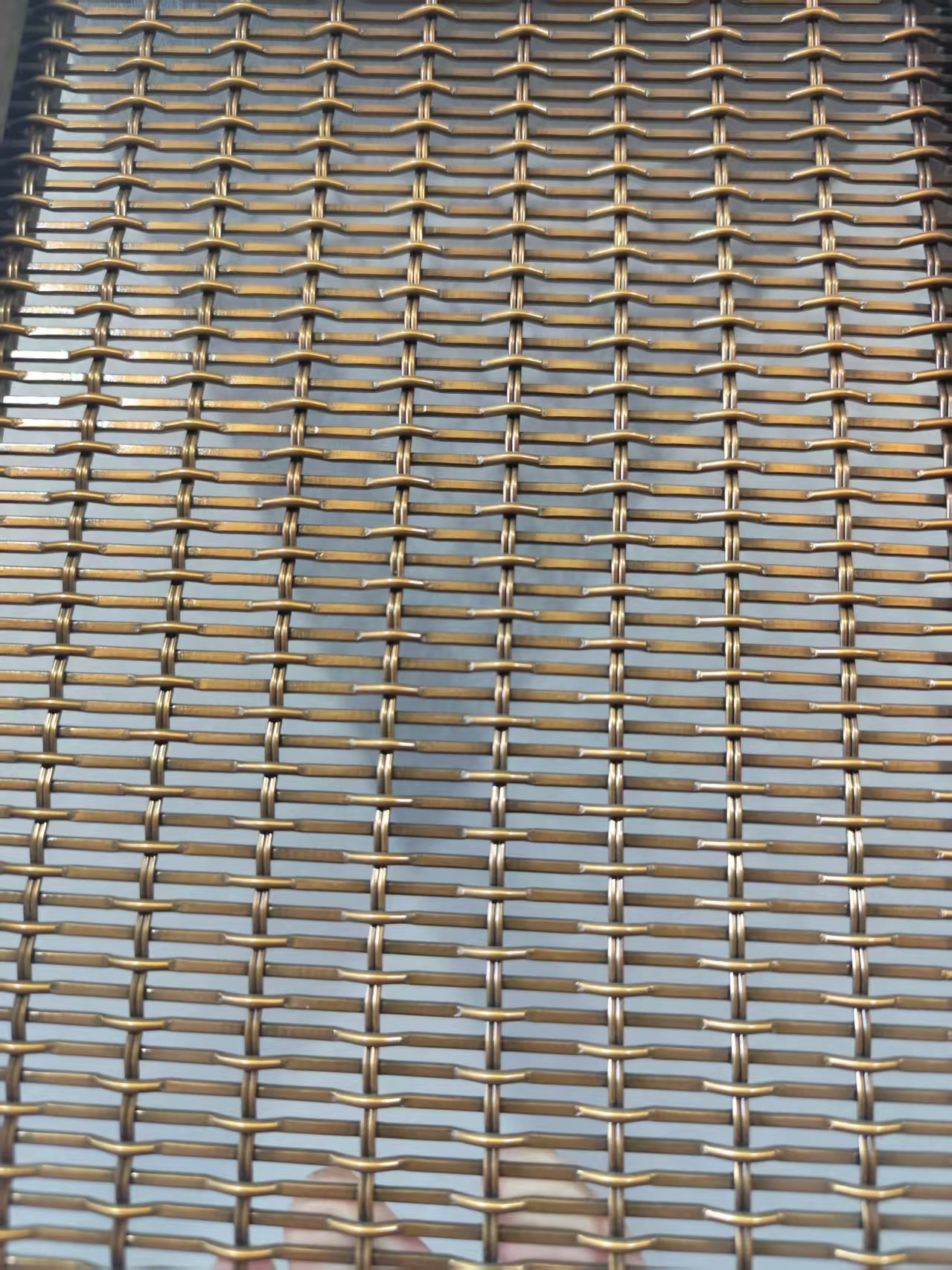
Product: Stainless steel crimped decorative mesh, material 304, flat wire + round wire weave structure, gold PVD titanium coating finish, custom width 2.8 meters.
Part 1: The Customer Came to Us – They Weren’t Buying “Mesh,” They Were Buying “Atmosphere”
In October 2025, Aisha, a partner at a Dubai design firm, contacted us via LinkedIn. Her company had just signed a contract for the lobby and corridor renovation of a high-end boutique hotel. The owner wanted to incorporate decorative elements that were “textured, layered, and interactive with lighting.”
Aisha said directly in our conversation:
“We tried several materials – wooden lattices felt too traditional, glass partitions felt too cold, and ordinary metal mesh looked like industrial shelving. We needed a material that is semi-transparent, three-dimensional, light-reflective, and refined enough for a luxury space. The architect recommended crimped decorative mesh, but the samples we got from other suppliers were either too rough, the color was wrong, or they couldn’t achieve the width we needed.”
Crimped decorative mesh is different from standard woven mesh. The warp and weft wires are pre-crimped (corrugated) before weaving, creating a raised, three-dimensional structure. Under lighting, this structure produces unique light-and-shadow refraction effects – exactly the kind of “layered” texture designers seek.
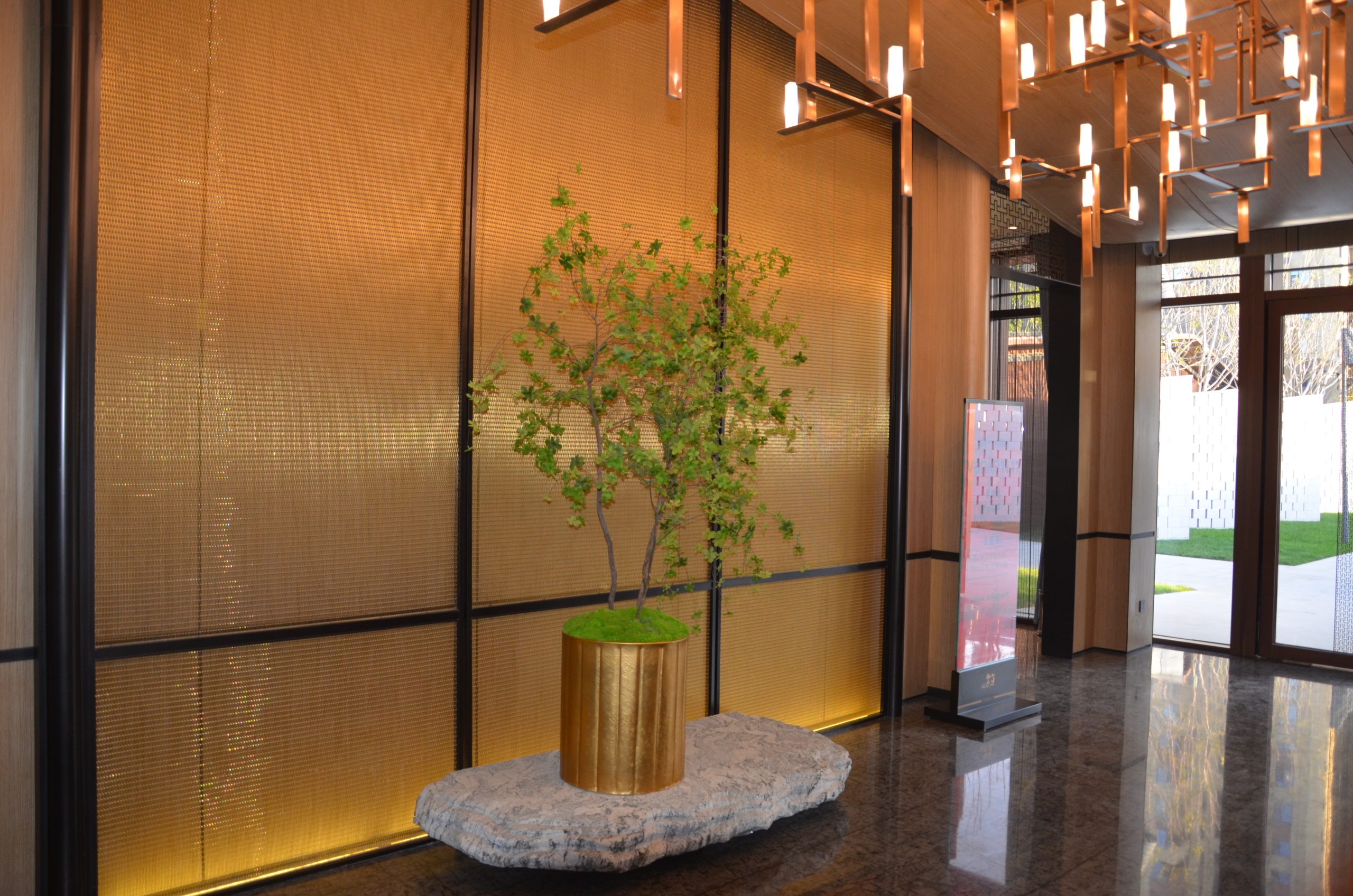
Aisha didn’t need a roll of mesh. She needed a decorative solution that would work with lighting to create spatial atmosphere.
Part 2: The First Thing We Did – Not a Quote, But “Reading the Design Intent”
Unlike industrial customers, we don’t start with specifications, quantity, and delivery. For decorative projects, we start with design intent.
We asked Aisha for three things:
- Rendering images– the final visual effect the designer wanted to achieve
- Lighting plan– fixture types, color temperature, and installation positions planned for the project
- Material references– photos of samples they had seen before, and what they didn’t like about them
After receiving the materials, we did something Aisha didn’t expect.
Instead of sending a price quote, we sent a “Crimped Decorative Mesh and Lighting Coordination Simulation Proposal” , which included:
. Recommended weave direction based on the renderings (the same mesh produces completely different light-and-shadow effects when installed horizontally vs. vertically)
. Recommended surface treatment based on lighting color temperature (gold PVD for warm light, silver brushed for cool light)
. Recommended mesh density based on installation location (open mesh for corridors to maintain transparency, tighter weave for lobby focal points)
Aisha later told us: this was the first time a supplier had “understood” their design before sending a price.
Part 3: How We Solved the Four Process Challenges Behind “Decorative Effect”
Once the design was confirmed, the real challenge began. Aisha wanted “refinement,” and in crimped decorative mesh production, “refinement” means solving four critical problems.
1. Color Consistency – The “Batch Curse” of Gold PVD Coating
With gold PVD titanium coating, color consistency within a single furnace batch is manageable. But if an order requires multiple production batches, color variation between different furnace runs is a well-known industry challenge.
We scheduled Aisha’s order as a single batch and reserved an additional 10% of material for potential on-site cutting losses. This ensured that if Aisha needed additional material for installation adjustments, she could draw from the reserved stock rather than requiring a new furnace run.
2. Mesh Flatness – The “Inherent Challenge” of Crimped Mesh
Because crimped mesh wires are pre-corrugated, they naturally have a textured surface. If tension is not carefully controlled during production, the mesh can develop uneven wave patterns – appearing chaotic and messy under light rather than orderly and refined.
We assigned one dedicated crimped mesh loom in Workshop 2 exclusively for this order. The tension control system on this loom is precisely calibrated to ensure each wire’s crimp amplitude is consistent, resulting in a uniform, regular textured pattern rather than random waves.
3. Width Limitation – The “Equipment Bottleneck” of Custom Width
Aisha needed 2.8-meter-wide mesh, while many manufacturers can only produce up to about 2 meters. Our Workshop 3 looms can be customized to over 3 meters in width – exactly what she needed.
More importantly, tension control on wide-width mesh is far more challenging than on narrow rolls. Our workshop manager spent considerable time calibrating the loom to ensure consistent tension across the full 2.8-meter width – no “flat on the left, warped on the right.”
4. Edge Finishing – The “Last Meter” of Installation Experience
During installation, raw cut edges – if rough – can ruin the refined look when viewed up close.
Before shipping, we applied edge finishing to both sides of every roll. The edges were clean, smooth, and burr-free. Aisha’s installation team could install the mesh immediately upon arrival, without any on-site edge trimming.
Part 4: The Results the Customer Achieved
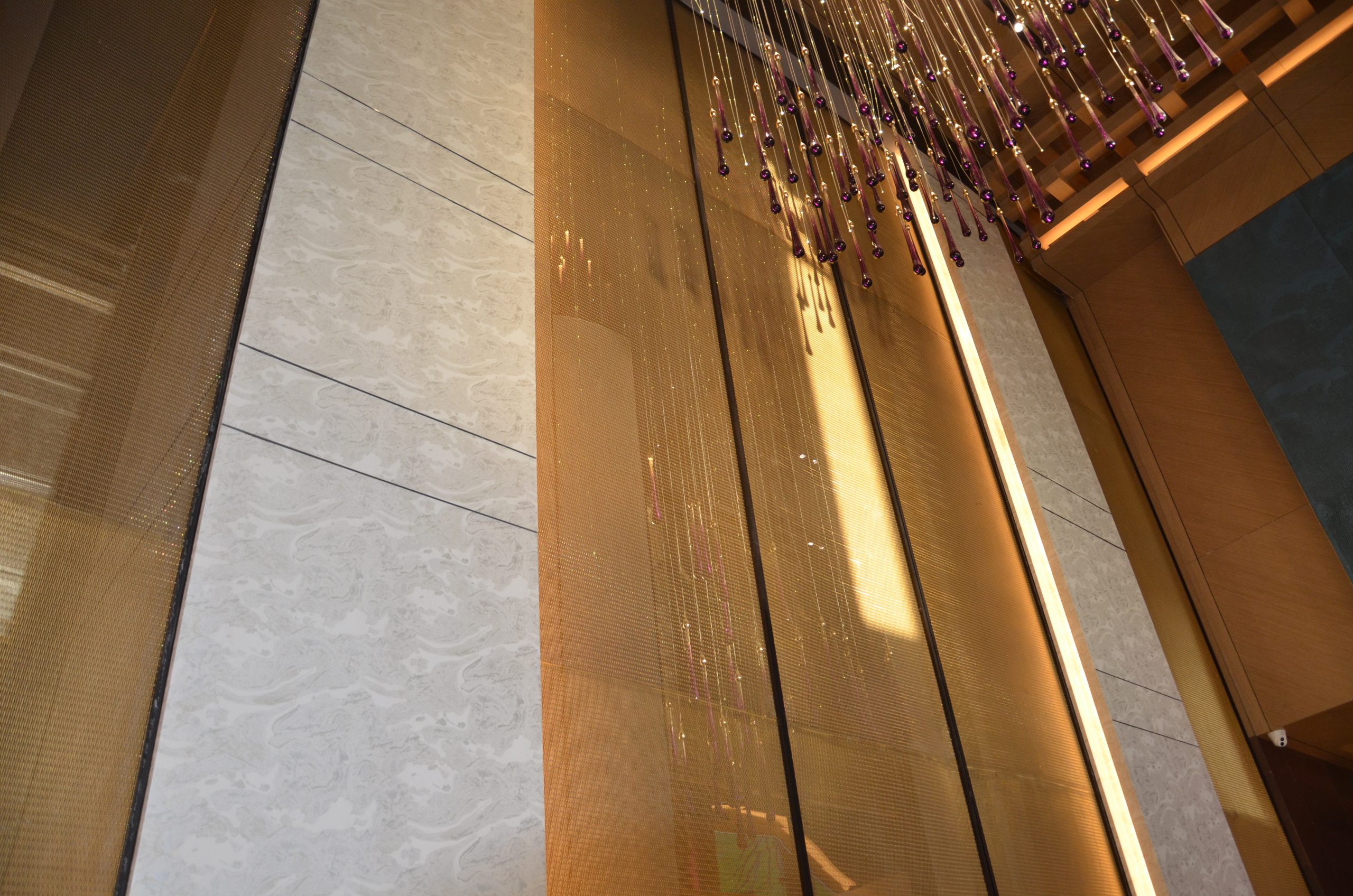
Aisha’s project was completed in January 2026 and passed final owner acceptance in early February.
| Parameter | Other Suppliers’ Samples | Hightop Finished Product |
| Gold color deviation (ΔE) | Above 2.0 | Below 0.8 |
| Mesh flatness | Uneven waves in some areas | Uniform, regular texture |
| Maximum width | 2.0m | 2.8m |
| Pre-installation preparation | Required on-site trimming | Edge-finished, install-ready |
| Owner feedback | N/A | “The space finally has a soul.” |
In her email after project completion, Aisha wrote:
“The interplay between the crimped mesh and lighting exceeded our expectations. The light and shadow in the corridors flow like water, and the lobby feature wall presents a golden layering effect under warm lighting. The owner said the space finally ‘has a soul.’ You didn’t just produce mesh – you helped us realize our design.”
Part 5: What This Case Demonstrates About Hightop Group
- Decorative mesh is not about specifications – it’s about effect
Aisha wasn’t buying “304 stainless steel mesh.” She was buying “layered light-and-shadow effects.” We started with design intent and won trust through solutions. - Process details determine decorative quality
Color consistency, flatness control, width customization, edge finishing – every detail is magnified in the final visual effect. - Speak the designer’s language
For architects and interior designers, what matters is color temperature, light and shadow, texture, and atmosphere. If you can communicate in their language, you’re no longer a vendor – you’re a partner.
Part 6: Does Your Project Require Similar Decorative Effects?
Crimped decorative mesh has a wide range of interior applications:
. Hotel lobbies and corridors – creating high-end, layered spatial atmospheres
. Commercial showrooms and retail spaces – brand identity and visual impact
. Office partitions and ceilings – modern, semi-transparent work environments
. High-end residential interiors – personalization and artistic expression
If your project requires any of the following, we should talk:
✅ Spatial atmosphere creation through lighting coordination
✅ Custom width requirements
✅ Consistent surface color across all panels
✅ Installation-ready delivery
Ready to start a conversation?
Please email us via the contact form below, we’ll get back to you as soon as possible.