
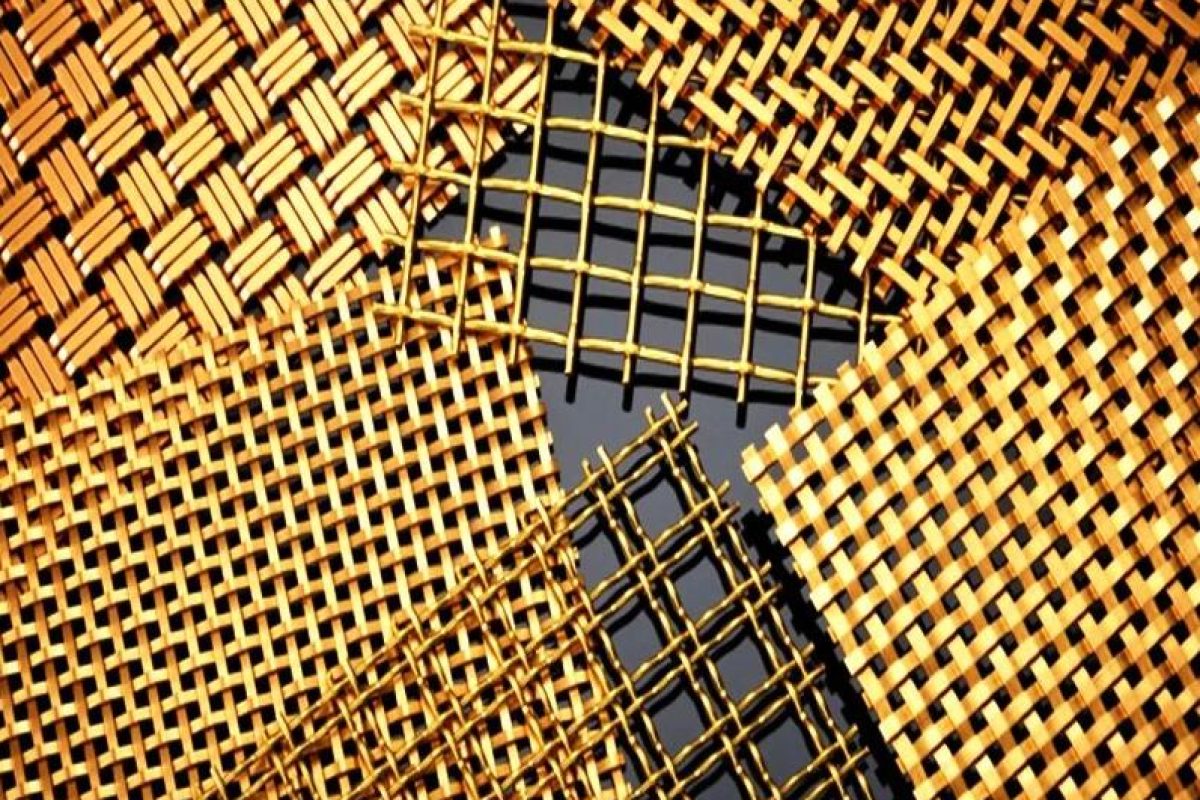
Gold mesh metal is a decorative woven wire material used where designers want the warmth of a gold-colored surface without giving up the strength and dimensional stability of stainless steel. For cabinetry and interior screens, the important questions are not simply whether the mesh looks gold, but how the finish, opening size, open area, wire profile and panel support affect the completed installation. HIGHTOP’s HTAR32 pattern combines stainless steel wire, flattened intersections and a sprayed gold-yellow finish for cabinet inserts, partitions and other decorative interior applications.
Article Summary
- HTAR32 uses stainless steel wire with a sprayed gold-yellow surface; it is not solid gold or brass mesh.
- Its 57% open area balances visibility, ventilation and visual screening.
- Panel dimensions, edge treatment, frame design and finish samples should be confirmed before ordering.
What Does “Gold Mesh Metal” Mean?
The term gold mesh metal describes appearance rather than one specific alloy or manufacturing method. Products sold under this name may be made from brass, copper alloy, stainless steel, aluminum or another base metal with a gold-colored coating.
HTAR32 is woven from 302, 304 or 316 stainless steel wire and finished with gold-yellow paint spraying. This construction provides the appearance of gold-toned decorative metal while the stainless steel wire forms the underlying structure.
This distinction matters during specification. Solid brass has its own natural color and may gradually change appearance through oxidation. Gold-painted stainless steel relies on a surface coating for its color, so coating consistency, handling and exposure conditions become important. A buyer should therefore describe the required base material and surface finish instead of requesting only “gold mesh.”
How the HTAR32 Structure Affects Its Appearance
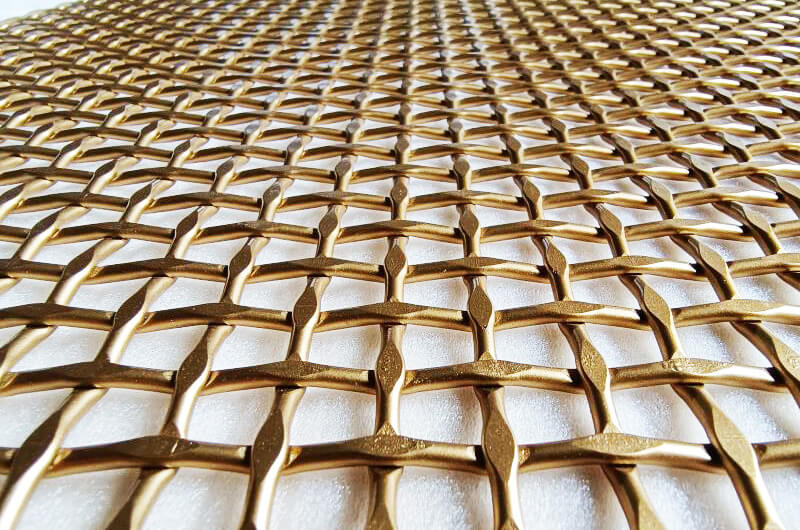
HTAR32 is not a flat printed sheet with decorative holes. It is a woven metal mesh made from 2.8 mm wire, with each intersection flattened during production. These flattened contact areas create broader reflective surfaces and make the crossing pattern more visible.
Under directional lighting, the rounded wire sections and flattened intersections reflect light differently. This produces more depth than a completely flat perforated panel. The final appearance can change with viewing distance, lighting direction, background color and the orientation of the mesh.
A dark backing generally makes the gold pattern appear stronger and increases visual contrast. A light or similarly colored backing creates a softer effect. For cabinet doors, the objects and interior surfaces behind the mesh will also influence the perceived color and openness.
Understanding the Key Specifications
The following values describe the standard HTAR32 configuration:
| Specification | HTAR32 Value |
|---|---|
| Base material | 302, 304 or 316 stainless steel wire |
| Surface | Gold-yellow paint spraying |
| Wire diameter | 2.8 mm (0.110 in.) |
| Opening size | 8.7 mm (0.343 in.) |
| Open area | 57% |
| Overall thickness | 3.6 mm (0.142 in.) |
| Approximate weight | 9 kg/m² (1.84 lb/ft²) |
These specifications should be considered together because changing one dimension may affect the opening, weight, stiffness and appearance.
What Does 57% Open Area Mean?
Open area is the proportion of the mesh surface that remains unobstructed by wire. A 57% open area means that slightly more than half of the panel area is open.
For cabinet inserts, this level of openness allows objects, lighting and backing materials to remain partly visible. It can also support passive airflow, although the mesh alone does not establish the ventilation performance of the complete cabinet or enclosure.
For partitions, 57% open area creates separation without forming an opaque barrier. It provides visual filtering rather than complete privacy. If stronger concealment is required, the designer may need a darker backing, smaller openings or a second material behind the mesh.
Why Opening Size Matters
The 8.7 mm opening influences what can be seen or pass through the panel. It is large enough to create a clearly recognizable woven pattern, making HTAR32 more appropriate for decorative use than fine filtration.
For furniture and cabinetry, the opening should be evaluated against the items stored behind it. Small objects, dust and light can pass through. If the cabinet requires insect exclusion, fine filtration or complete dust control, this decorative mesh should not be treated as the only functional barrier.
Overall Thickness and Frame Depth
The mesh has an overall thickness of approximately 3.6 mm, which is greater than its 2.8 mm wire diameter because of the woven structure. Frame grooves, retainers and backing systems must accommodate the finished thickness rather than only the wire diameter.
A shallow groove can prevent the mesh from sitting flat. Excessively tight fastening can damage the coating or introduce visible distortion. The frame design should hold the panel securely while allowing for actual manufacturing tolerances.
Weight and Panel Support
At approximately 9 kg/m², HTAR32 is substantial enough that panel size and support method deserve attention. A small cabinet insert may require only perimeter retention, while a large decorative panel may need intermediate support or a rigid subframe.
The quoted weight should not be interpreted as a load-bearing rating. Panel rigidity depends on dimensions, orientation, edge condition, tension and framing. The mesh should not be specified as a guard, balustrade or fall-protection component without a separately designed and verified supporting system.
Suitable Interior Applications
Cabinet and Furniture Inserts
Gold mesh can replace solid door centers in kitchen cabinets, wardrobes, display furniture, entertainment units and bar cabinetry. The pattern adds texture while allowing partial visibility and ventilation.
For a coordinated result, compare the gold-yellow finish with handles, hinges, lighting and adjacent metalwork. Products described as gold, brass, bronze or champagne can differ noticeably when placed together.
Decorative Partitions
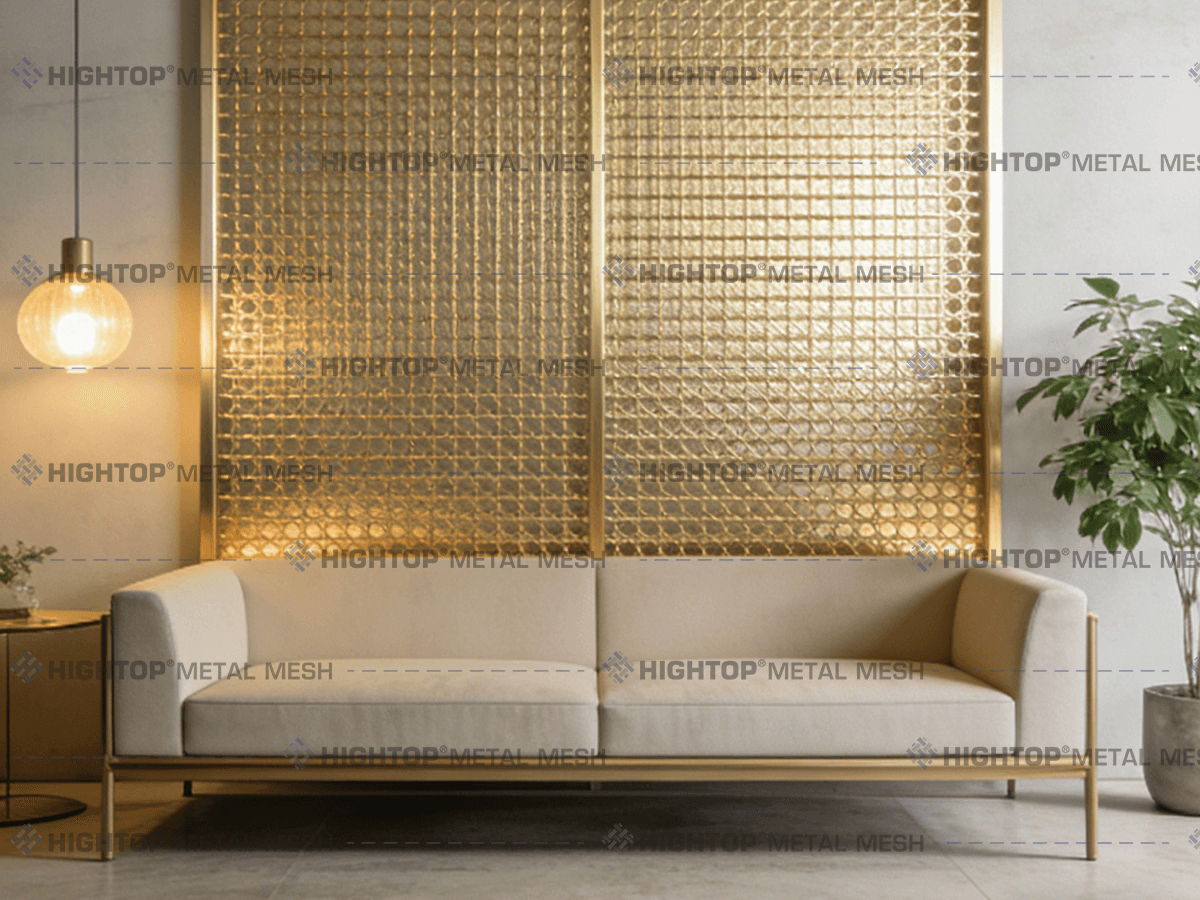
HTAR32 can be framed as a screen between interior zones where some visual connection is still desired. Possible locations include hospitality interiors, retail displays, reception areas and feature walls.
Because the mesh remains 57% open, it should be used as a visual divider rather than an acoustic or privacy barrier. The frame, fixing points and panel size determine the stability of the installed screen.
Radiator Covers and Ventilated Panels
The open structure may be considered for decorative covers that require airflow. However, suitability depends on temperature, clearance, coating limitations and the requirements of the equipment behind the panel.
The gold-colored finish should not be assumed to tolerate every heating condition. Buyers should provide the expected service temperature before selecting the mesh for heating or ventilation equipment.
Choosing the Stainless Steel Grade
HTAR32 can be produced using 302, 304 or 316 stainless steel wire, but the grade should match the environment rather than being selected only by price.
For dry interior cabinetry, the project may not require the corrosion resistance associated with a more highly alloyed grade. In humid interiors, food-service areas or locations exposed to cleaning chemicals, the operating conditions should be reviewed more carefully. Grade 316 is commonly considered for more demanding chloride exposure, but it does not make the coating immune to damage or guarantee suitability for every coastal environment.
The sprayed finish becomes the visible surface, so base-metal selection and coating selection solve different problems. Stainless steel supports the underlying mesh, while the coating provides the specified gold-yellow appearance.
Installation and Finish Considerations
The decorative result depends heavily on fabrication and installation. Buyers should confirm the visible face, pattern direction and final panel dimensions before cutting begins. When several panels appear side by side, consistent orientation helps maintain a continuous visual rhythm.
Cut edges should normally be concealed inside a frame or finished with an appropriate border. Installers should avoid dragging coated mesh across hard surfaces because scratches may expose or visibly mark the finish. Protective packaging should remain in place until the panel is ready for installation.
A physical finish sample is advisable when color matching is important. Screen settings, photography and surrounding light can make the same gold coating appear warmer, darker or more reflective than it does in the finished space.
Specifying HTAR32 with HIGHTOP
HIGHTOP Wire Mesh produces woven decorative mesh for architectural and furniture applications. The HTAR32 gold decorative wire grille is available in the stated stainless steel grades with a gold-yellow sprayed finish. Project-specific requirements can be discussed, but any change to material, dimensions or finish should be confirmed because it may also change weight, appearance and production feasibility.
For an accurate inquiry, provide:
- Required panel or roll dimensions and quantity
- Intended application and installation environment
- Preferred stainless steel grade
- Pattern direction and visible face
- Frame, edge or cutting requirements
- Finish sample or color reference, if matching is required
Frequently Asked Questions
Is This Gold Mesh Made from Brass?
No. HTAR32 is woven from stainless steel wire and receives its gold-yellow appearance from a sprayed surface finish. It should not be specified as solid brass mesh.
Can HTAR32 Provide Complete Privacy?
No. Its 57% open area allows substantial visibility through the mesh. Privacy can be increased with a backing panel, greater viewing distance or controlled lighting, but the finished effect should be evaluated with a sample.
Can the Mesh Be Used Outdoors?
Outdoor suitability cannot be determined from the stainless steel grade alone. Exposure to moisture, chlorides, ultraviolet light and cleaning chemicals may affect both the base material and sprayed finish. Provide the location and exposure conditions for confirmation before specifying exterior use.
Please email us via the contact form below, we’ll get back to you as soon as possible.